Purchase order
PO-0001
- Vendor
- Vendor A
- Ship to
- Main warehouse
- Approval
- Approved
ItemQtyPriceAmountItem A1050.00500.00
Apergu implements ERP systems that connect finance, inventory, procurement, and operations so your business runs on one accurate source of truth.
The gap between those tools is where margin, time and trust quietly leak out — and it never shows up as a line item on anyone’s budget. ERP closes the gap by making one record the only record.
01
Audit current processes and pain points.
02
Re-engineer workflows and map them to the system.
03
Build, customise, and integrate.
04
Role-based team onboarding.
05
Post-go-live optimisation.
The spreadsheet trap
Manual reconciliation between systems is not a workflow. It is a full-time job nobody signed up for.
The stock illusion
Sales sees one number, the warehouse sees another, and the customer finds out the truth when their order does not ship.
The approval black hole
Every request looks reasonable on its own. Nobody sees the total until the budget is already blown.
The growth ceiling
What felt good enough during the early years quietly becomes the biggest constraint on how fast you can grow.
The reporting lag
Real-time business needs real-time data, not a number that was accurate three weeks ago.
Most companies do not fail because they lack systems. They fail because their systems do not talk to each other.
Each document is created from the one before it, so quantities and prices are entered once — then referenced and checked, never retyped.
Vendor bill
BILL-0001
Qtyfrom GRPricefrom PO
Three-way match
MatchedStage 01 · Order
Stage 02 · Receive
Stage 03 · Bill
An example flow with sample values. Each implementation is configured to the client’s own process — document types, approval routes and matching tolerances differ from company to company.
Eliminate data silos. Every department accesses the same real-time data.
Seamless flow from procurement through to fulfilment.
Generate financial statements in minutes, not weeks.
Automate approvals, alerts, invoicing, and routine tasks.
Cloud ERP adapts to your growth without a re-implementation.
Modern ERP is the base layer for AI insights and predictive analytics.
Take a closer look at our products and find the right solution for your business.
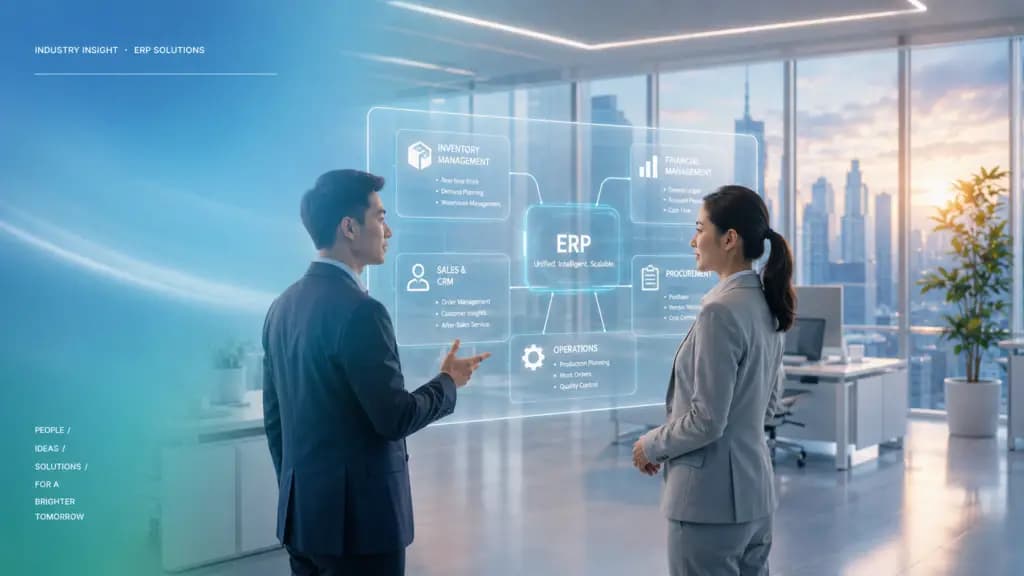
Apergu connects finance, inventory and operations into one live ERP system, so every number tells the same story, everywhere, all the time.