8 min read
Every year, businesses across Indonesia invest in new technology — ERP systems, CRM platforms, helpdesk tools, marketing automation. The demos look great. The sales pitch is convincing. The contract gets signed.
Then reality hits.
The system does not match your workflows. Your team does not know how to use it. The data migration is a mess. The vendor who sold you the licence has already moved on to their next deal. And three months later, half your team is quietly back on spreadsheets.
This is not a software problem. This is an implementation problem. And it is exactly why Apergu exists.
What makes Apergu different
End-to-end implementation
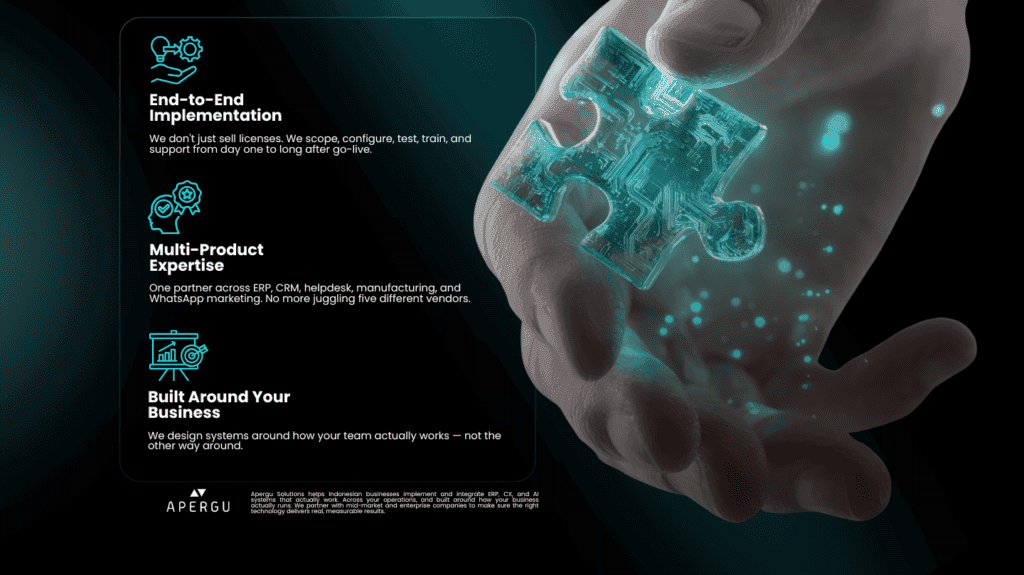
Most vendors sell you a licence and hand you a login. Apergu does the opposite. We start before the software is even selected — understanding your operations, mapping your workflows, identifying your pain points — and we stay long after go-live to make sure the system actually works in the real world.
Our implementation process covers every stage: discovery, scoping, system design, configuration, data migration, integration, testing, training, go-live, and ongoing support. There is no phase where we disappear and leave you to figure it out.
This matters because implementation is where most technology investments fail. Not because the software is bad, but because nobody took the time to set it up properly. We take that time. Every time.
Multi-product expertise
Most businesses do not just need one tool. They need an ERP for their back office, a CRM for their sales team, a helpdesk for customer support, and a marketing channel that actually reaches people. The typical approach is to hire a different vendor for each one — and then spend months trying to get them all to work together.
Apergu eliminates that problem. As a licensed partner for NetSuite, Epicor, Zendesk and Mekari Qontak — and the creator of Amaze, our own WhatsApp broadcast platform — we cover your entire tech stack under one roof.
One partner. One team. One point of accountability. No more finger-pointing between five different vendors when something breaks.
Built around your business
We do not believe in templates. Every business operates differently — different approval workflows, different reporting needs, different team structures, different pain points. A system that works for one company will not automatically work for another, even in the same industry.
That is why every Apergu implementation starts with your operations, not a pre-built configuration. We design the system around how your team actually works — not the other way around. The result is software that feels intuitive from day one, because it was built to match the way your people already think and operate.
The Apergu implementation process
We follow a structured, proven methodology on every project. No shortcuts. No skipped steps.
Phase 1 — Discovery
We sit with your operations, finance, sales and IT teams to understand how your business runs today. Not how it should run on paper. How it actually runs. The good, the messy, and the "we have been doing it this way for years and nobody knows why".
Phase 2 — Solution design
Based on discovery, we design your complete system architecture — which modules, what workflows, how data flows between systems, what reports you need, and what integrations are required. You review and approve everything before we touch a single configuration.
Phase 3 — Configuration and build
We configure the system to match your approved design. Custom fields, user roles, automation rules, dashboard layouts, production routings, approval hierarchies — everything is built to your specifications. Not a template. Yours.
Phase 4 — Data migration
Your historical data matters. We clean, map and migrate your data into the new system — accounts, contacts, transactions, inventory records, open orders — with validation checks at every step to make sure nothing gets lost or corrupted in the move.
Phase 5 — Testing
We run multiple rounds of testing before anything goes live. Unit testing for individual modules. Integration testing to make sure systems talk to each other correctly. And user acceptance testing with your actual team, using your actual data, in your actual scenarios.
Phase 6 — Training
We do not do generic training. Every session is role-based and built on your system, your data and your workflows. Your finance team learns finance. Your sales team learns CRM. Your warehouse team learns inventory. Everyone walks away confident, not confused.
Phase 7 — Go-live and ongoing support
Go-live is not the finish line. It is the starting line. We are on-site or on-call during launch, and we stay engaged for ongoing optimisation, troubleshooting and system health checks. The first 90 days after go-live are critical — and we treat them that way.
Why implementation matters more than software selection
Here is something the software industry does not like to admit: the difference between a successful deployment and a failed one almost never comes down to which software you chose. It comes down to how it was implemented.
A well-implemented mid-range ERP will outperform a poorly implemented enterprise ERP every single time. Because a system your team actually uses, with data they actually trust, producing reports that actually match reality — that is what drives business results. Not features on a spec sheet.
Do not just choose the right software. Choose the right partner to make it work.